Friday, September 23, 2016

Cut and Copy and Paste, Oh my!

Image result for copy and paste

After recently talking about memory in my computer science class, I became curious as to how copy and paste interacted with the memory of a computer.  Like we do with most things concerning computers, we don't really think about what happens when we press command+c, command+v, or command+x (or control+ if you have a PC).  Regardless, when these commands are given, the software in your computer goes through a complex game of switcheroo by taking information in one part of the memory and putting it somewhere else.

Your computer's operating system has a "clipboard" where the computer duplicates information that is in one part of memory and stores it in another part. An interesting feature of clipboard is that it is controlled by the operating system, meaning that you can cut, copy, and paste information between applications. So definitely thank clipboard the next time you want to cut a quote from word and paste it on facebook or copy a picture from google and paste it on your next blog post.
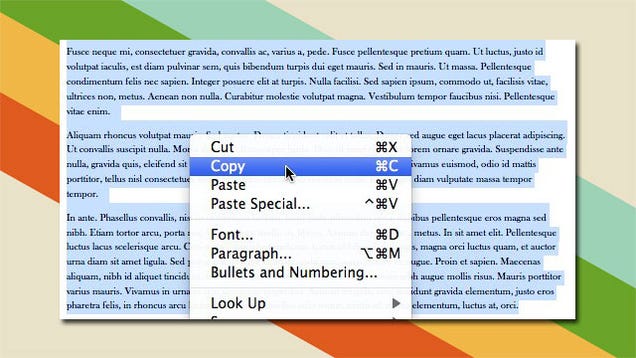
Image result for cut copy paste


Specifically, cutting involves removing information from a place in memory and then storing it temporarily on clipboard until it is accessed again through the paste function or until something else is stored on clipboard. This is starkly different from copying as copying involves duplicating information in one piece of memory and moving the copy to clipboard. This is different from cutting as the original information is still in its original place in memory. Finally, pasting involves taking the information from its temporary place in clipboard and putting it into a new, more permanent place in memory. And because the information is stored in clipboard, the paste function can access the information multiple times until the information on clipboard is changed.

References:
 @computerhope. "What Is Copy?" What Is Copy? N.p., n.d. Web. 23 Sept. 2016.
@computerhope. "What Is Cut?" What Is Cut? N.p., n.d. Web. 23 Sept. 2016.
 @computerhope. "What Is Paste?" What Is Paste? N.p., n.d. Web. 23 Sept. 2016.
"PC Help Center." What Is Copy and Paste and How Does It Work? N.p., n.d. Web. 23 Sept. 2016.
Pinola, Melanie. "How to Copy, Cut, and Paste for Beginners." Lifehacker. N.p., 13 May 2011. Web. 23 Sept. 2016.
"Work From Home Opportunity - CopyPasteProducts.com."CopyPasteProductsCom. N.p., n.d. Web. 23 Sept. 2016.

Friday, September 16, 2016

EEG and Video Games??

Image result for epoc technology

Even if you don't know the term EEG, I'm sure you've all heard of or seen that instrument in psychology that has multiple white rods protruding from someone's skull. That instrument is called an electroencephalogram, or EEG, and it measures the electrical activity of the brain. The more thoughts and emotions you have and the more motions you make, the more activity appears on the EEG.

Image result for epoc technology

Now how is this related to computer science? Companies now are making those bulky machines portable and more accessible to the common person.  This is because those portable headsets are connected to a brain computer interface (BCI) that can read and interpret conscious and unconscious thoughts, emotions, and motions. To make a profit, those companies then connect those headsets to gaming systems in which your thoughts take control of the game. For instance, after setting up the controls of the headset, the game could send you a command to select a certain option or make a specific motion.  The EEG headsets collect the data from your brain and implements it into the game. Even more amazingly, because your brain interprets visual stimuli, the EEG headsets can take that data and create a more realistic world within the game. As time goes on and you continue to use the headsets, BCI continues to collect data from your brain activity in order to make the game even more realistic and attuned to you. And though the idea of letting companies have access to our thoughts and emotions are scary, this technology is pretty incredible and can be used to further many other fields of study.

References:

"EEG (Electroencephalogram)." KidsHealth - the Web's Most Visited Site about Children's Health. The Nemours Foundation, n.d. Web. 16 Sept. 2016.
@emotiv. "EMOTIV - Brainwear® Wireless EEG Technology." Emotiv. N.p., n.d. Web. 16 Sept. 2016.


 Http://www.howstuffworks.com/about-author.htm. "How the Emotiv EPOC Works." HowStuffWorks. N.p., 10 Dec. 2008. Web. 16 Sept. 2016.

Friday, September 2, 2016

Spotify

While there are many comparable music streaming programs like Pandora and Slacker, I'm going to look at Spotify and how it relates to computer science in this blog entry. After the Spotify software is installed into your computer's hardware, your computer is entered into the peer-to-peer (P2P) network in which your computer sends data to Spotify's network and Spotify's network sends data to you and to any computer that is wired into the P2P network. 
Image result for spotify logo


When a song or album is selected, it sends a command to the software to transmit the data to your computer. In the same way, when the song or album has been completed, your computer is sent a command to transmit the data back through the P2P network. If the song or album is downloaded to the computer, the data is actually stored into the computer and is not sent back through the P2P network. 
Image result for spotify streaming


The data that is sent through the P2P network is in the Vorbis format because it creates small and easily transferred files. The result is a shorter latency which means that the time between picking a song and hearing it play is much shorter. It also starts "pre-fetching" the next song in your playlist or album to help reduce the wait between songs even more. What do all of these things mean? Spotify has thoughtfully manipulated its programming and streaming system to give us the best music experience it can. Thanks Spotify!

References:
http://electronics.howstuffworks.com/gadgets/audio-music/spotify6.htm
http://www.dummies.com/social-media/spotify/how-spotify-works/
https://www.engadget.com/2012/10/09/samsung-spotify-smart-tv/
http://gizmodo.com/5995060/how-spotify-got-itself-a-new-logo

GPS

GPS (Global Positioning System) is a complicated web of technology that has commonly and easily been taken for granted. Most of us even reference the system incorrectly. When we say "GPS," we're actually referring to the GPS receiver which, as the name suggests, receives input from a system of satellites in space (the actual GPS) to compute your location.

Image result for gps

The GPS receiver primarily works by using 3-D trilateration.  In simplified terms, the receiver on Earth receives transmission from the different satellites in space and  relates them to its/your location. The transmission that the satellites give off is a "long, digital pattern called pseudo-random code." The receiver can determine location because the transmission is interrupted when it comes into contact with the receiver. The amount of time that the transmission is interrupted corresponds to the amount of distance between the satellite and the receiver which gives the receiver a reference point to work with. Once the receiver has received enough information from multiple satellites, it can calculate and output your location and provide a path to your desired location by continuously collecting information from satellites as it moves. In order to improve accuracy, the receiver stores the memory of each satellites' location as well as map detailed files in its software. Based on this explanation, you can easily see that GPS is a great example of a common, household tool that works because of algorithms and computer science.

Image result for gps

References:
http://www.academia.edu/7304657/A_Review_on_GPS_and_its_Applications_in_Computer_Science_
http://electronics.howstuffworks.com/gadgets/travel/gps5.htm
http://www.figonet.com/en/building-blocks/sensors/gps/
http://sonc.dvrlists.com/gps/